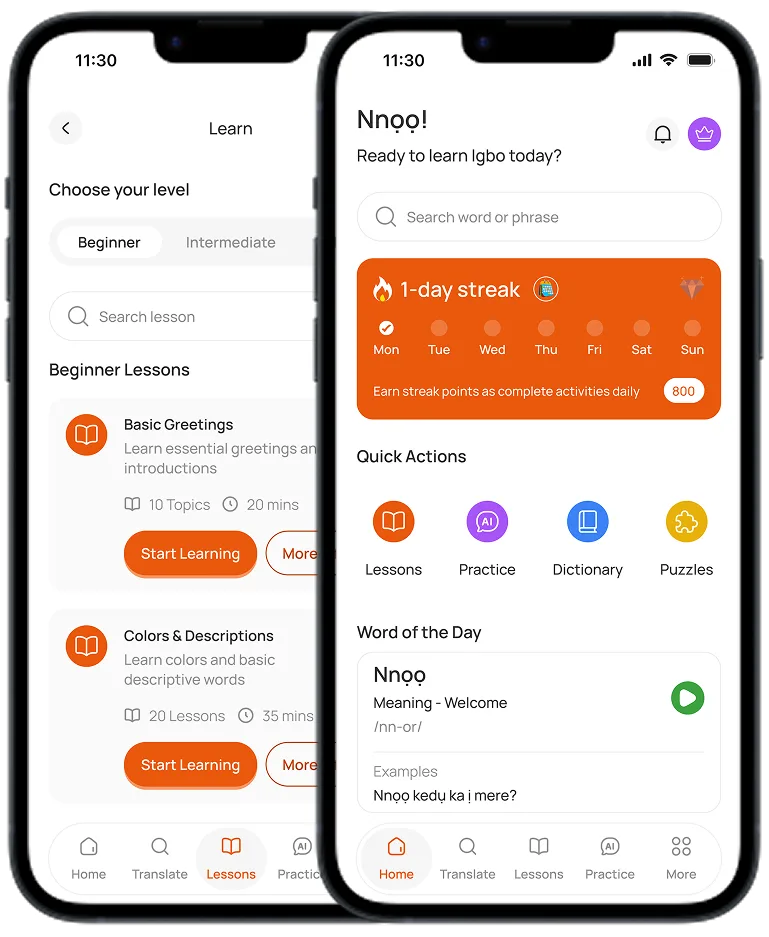

1. Greetings first
Start with kedu, daalụ, and ịbọla chị. They are short, they repeat constantly, and they give you something to say to a parent or grandparent immediately. See the full greetings guide.
Most guides tell you to “immerse yourself” and leave it there. This one is specific: what to learn first, how to handle tone without studying tone rules, how long it actually takes, and what a realistic week looks like. Written for complete beginners and for heritage learners who understand more than they can say.
THE PATH
The order matters more than the material. Learners who start with grammar tables usually quit; learners who start with greetings usually keep going, because they get to use the language with a real person in week one.
Start with kedu, daalụ, and ịbọla chị. They are short, they repeat constantly, and they give you something to say to a parent or grandparent immediately. See the full greetings guide.
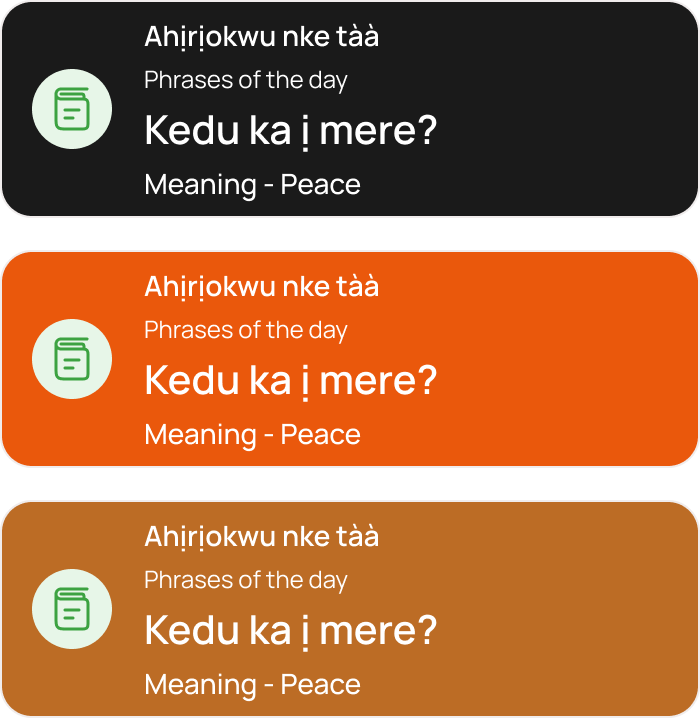
Igbo is tonal — pitch changes meaning. Do not learn a word silently and add the tone later; that means learning it twice. Imitate native audio from the first word. The pronunciation guide covers the sounds English does not have.

Frequency beats duration. Fifteen minutes every day will take you further than two hours on a Sunday, because vocabulary decays fast in the first weeks and daily contact is what stops the decay.

An isolated word list is hard to recall under pressure. Learn ọ dị mma as a phrase you can say, not as three entries. Look words up in context in the Igbo dictionary where each entry carries examples.

Every learner waits too long. Say your imperfect sentence to a family member, a tutor, or the app’s AI practice. Being corrected once is worth a week of silent study.
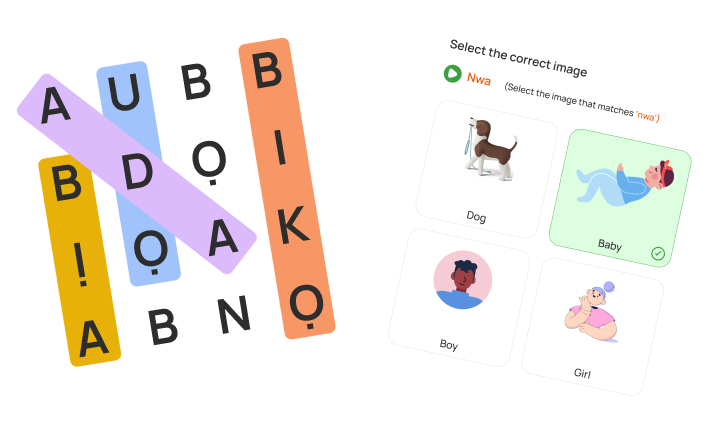
Come back to old words on purpose — puzzles and quick drills work well for this. Anything you learned three weeks ago and never revisited is, in practice, gone.
HOW LONG IT TAKES
These are typical, not guaranteed. Heritage learners who already hear Igbo at home usually move through the first two stages considerably faster, because the sounds are already familiar even when the vocabulary is not.
WHERE TO PRACTISE
You do not need many resources. You need one place to hear words correctly, one place to look things up, and one person to speak to.
Native audio on every entry, so you are copying a speaker rather than guessing from spelling. This is the part you cannot substitute with a text resource. Get the app.
A dictionary that shows meaning, tone marking, and an example sentence together. Search the Igbo dictionary.
Structured lessons beat browsing, because they stop you collecting words you will never use. Browse Igbo lessons.
A family member is best. Failing that, a tutor or AI practice will correct you without the fear of embarrassment. Find a tutor.
COMMON QUESTIONS
Straight answers, including the ones that are less encouraging than you might like.
With 15 focused minutes a day, most beginners can greet people, introduce themselves, and hold a short exchange within about three months. Comfortable everyday conversation usually takes a year or more. Heritage learners who already hear Igbo at home tend to move faster, because the sounds are familiar even when the vocabulary is not.
The grammar is more forgiving than most European languages — there are no gendered nouns and verb forms are regular. The genuinely hard part is tone: the same spelling can carry different meanings depending on pitch. That is why listening to native audio from day one matters more in Igbo than in Spanish or French.
No. Duolingo does not offer an Igbo course. Learners looking for that experience generally use a dedicated Igbo app instead, which is what IgboLearn was built to be.
You do not need to study tone rules as theory, but you should imitate native audio from your very first word. Learning a word silently and adding the tone later means relearning it. Hearing it correctly once is far easier than correcting it twice.
Greetings. They are short, they repeat constantly, and they let you use the language with a real person on day one — which is the thing that keeps most learners going. Start with kedu, daalụ, and ịbọla chị, then move to introducing yourself.
No. Adults learn vocabulary and grammar faster than children; what children do better is absorbing tone and accent without effort. That gap is worth closing with native audio, not with worry.
KEEP READING
The first words and phrases to learn, with audio.
Why there is no Igbo course on Duolingo, and what to use instead.
What IgboLearn includes, and who it is built for.
Tone, vowels, and the sounds English does not have.
Morning to night, with the responses that go with them.
Studying Igbo remotely, from anywhere in the diaspora.
Greetings, native audio, and a dictionary that explains itself. Learn Igbo in the time you would spend scrolling.