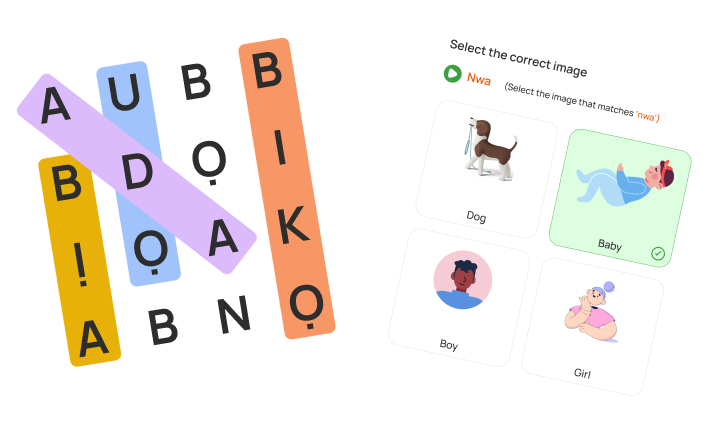
Igbo crosswords
Clues in English, answers in Igbo. Forces recall rather than recognition, which is the harder and more useful direction — and the one that shows up when you actually need a word.
Reading a word list is easy and forgettable. Being asked to retrieve a word — and briefly failing — is what fixes it in memory. That is the whole reason these games exist, and why five minutes of them beats twenty minutes of rereading.
WHAT YOU CAN PLAY
Each one drills something different. If you only ever play the one you are good at, you will get very good at that and no better at Igbo.
Clues in English, answers in Igbo. Forces recall rather than recognition, which is the harder and more useful direction — and the one that shows up when you actually need a word.

Pair Igbo words with meanings against the clock. Good for a first pass over new vocabulary, and forgiving enough to play when you are tired.
Short multiple-choice rounds by topic — family, food, numbers, greetings. Useful for finding out which set you only think you know.

One short round a day. The point is the habit rather than the score — see also the Igbo word of the day.

Hear a word, choose the meaning. The only game type that trains tone, which is the part of Igbo that written practice cannot reach at all.

Short enough for children and competitive enough that adults stay interested. Playing together works better than supervising. See Igbo for kids.
WHY THIS WORKS
Rereading a list produces a strong feeling of knowing and weak recall. Being tested produces the opposite, which is why it feels worse and works better.
HOW TO USE THEM
Games consolidate vocabulary you have met; they are poor at introducing it cold. Learn a set in a lesson first, then drill it here.
The failed attempt is doing the work. Guessing and missing before seeing the answer beats being shown the answer first, uncomfortable as that is.
Silent play trains reading, not speaking. Saying each answer aloud costs nothing and practises the thing you actually want to be able to do.
When a word keeps catching you, read its full entry with audio and examples in the dictionary rather than guessing again next round.
KEEP GOING
The full puzzle collection inside IgboLearn.
Where games fit in a step-by-step plan.
Playful practice built for younger learners.
A good vocabulary set to drill with quizzes.
The set worth knowing cold before anything else.
For when vocabulary starts feeling easy.
Crosswords, quizzes, and daily challenges with native audio — free to start.