Tone & meaning
Two words written the same way can mean different things depending on tone. IgboLearn helps you hear and understand the difference.
Most online translators struggle with Igbo tone, context, and culture. IgboLearn combines dictionary, examples, and AI tools so you understand what a phrase means and how to use it.
BEYOND DIRECT TRANSLATION
Word‑for‑word translation can be misleading in Igbo. Context, tone, and politeness levels all change what you should say.
Two words written the same way can mean different things depending on tone. IgboLearn helps you hear and understand the difference.

Some expressions are friendly with friends but too casual with elders. The app helps highlight context and respect.

Use puzzles to practise the words and phrases you translate so they stick beyond one quick lookup.
INSIDE IGBOLEARN
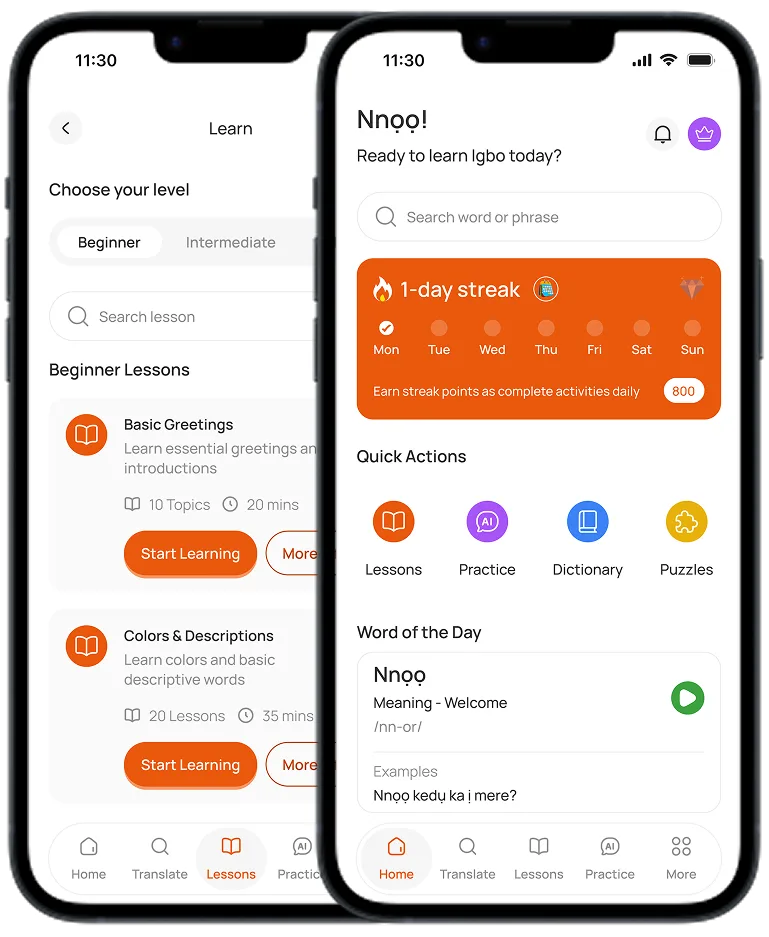
Instead of a one‑line answer, you get meaning, examples, and pronunciation in one place.
BOTH DIRECTIONS
Translating into Igbo is the harder direction, and it is the one most tools handle badly. English collapses distinctions Igbo keeps, so a single English word often has several Igbo translations that are not interchangeable.
Usually straightforward for single words, and the place where a plain dictionary lookup is enough. Where it goes wrong is idiom: a phrase can be entirely transparent word by word and still mean something else in use.
Much harder. “You” alone splits by number, and respect shapes how you address someone older. A translation that ignores this is grammatical and still lands wrong, which is why context matters more than a word swap.
Igbo is tonal, and identical spellings can carry different meanings at different pitches. Written translation alone cannot show you this — you need the audio, which is why every dictionary entry here carries it.
Igbo has substantial regional variation. Standard Igbo is what you will see in most written material, but the word your family uses at home may differ and still be perfectly correct.
WHAT TO WATCH FOR
Worth knowing before you rely on any translator — this one included — for anything that matters.
Machine output tends to render Igbo idioms word for word, producing something grammatical and meaningless. If a translation reads oddly, an idiom is the usual reason.
Many Igbo names are compressed statements, not labels. Translating one as a name loses the meaning entirely — see Igbo names and their meanings.
A proverb’s meaning lives in when it is said, not in its words. Read them with their context in Igbo proverbs and meanings.
BEYOND LOOKUP
If you are translating the same words repeatedly, that is a sign to learn them properly rather than look them up again.
Meaning, native audio, and example sentences for each entry. Open the Igbo dictionary.
Structured lessons stop you collecting vocabulary you will never use. Browse Igbo lessons.
Tone is the part translation cannot teach you. Read the pronunciation guide.
A plain, ordered path from your first word onward. How to learn Igbo.
Download IgboLearn to combine translation, pronunciation, and cultural context in one app.