
Games & puzzles
Igbo word games that make vocabulary stick.
Reading a word list is easy and forgettable. Being asked to retrieve a word – and briefly failing – is what fixes it in memory. That is the whole reason these games exist, and why five minutes of them beats twenty minutes of rereading.
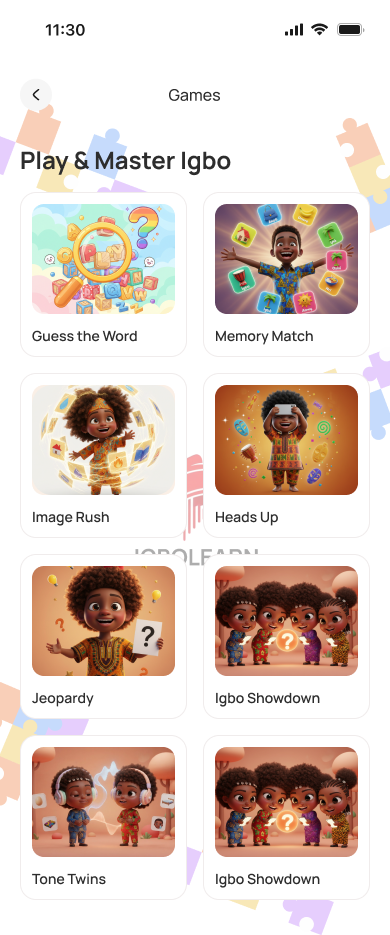
WHAT YOU CAN PLAY
Various ways to practise Igbo without it feeling like study
Each one drills something different. If you only ever play the one you are good at, you will get very good at that and no better at Igbo.
Igbo crosswords
Clues in English, answers in Igbo. Forces recall rather than recognition, which is the harder and more useful direction – and the one that shows up when you actually need a word.
Word matching
Pair Igbo words with meanings against the clock. Good for a first pass over new vocabulary, and forgiving enough to play when you are tired.
Vocabulary quizzes
Short multiple-choice rounds by topic – family, food, numbers, greetings. Useful for finding out which set you only think you know.
Daily challenges
One short round a day. The point is the habit rather than the score – see also the Igbo word of the day.
Listening rounds
Hear a word, choose the meaning. The only game type that trains tone, which is the part of Igbo that written practice cannot reach at all.
Family rounds
Short enough for children and competitive enough that adults stay interested. Playing together works better than supervising. See Igbo for kids.
WHY THIS WORKS
Games are not a lighter version of studying. They are a different mechanism.
Rereading a list produces a strong feeling of knowing and weak recall. Being tested produces the opposite, which is why it feels worse and works better.
Retrieval
Pulling a word from memory strengthens it; recognising it on a page barely does.
Spacing
Words resurface days later, right around when you would otherwise lose them.
5 minutes
Short enough that you actually do it on the days you do not feel like it.
HOW TO USE THEM
Getting real value out of five minutes
Play after learning, not instead of it
Games consolidate vocabulary you have met; they are poor at introducing it cold. Learn a set in a lesson first, then drill it here.
Let yourself get it wrong
The failed attempt is doing the work. Guessing and missing before seeing the answer beats being shown the answer first, uncomfortable as that is.
Say the answers out loud
Silent play trains reading, not speaking. Saying each answer aloud costs nothing and practises the thing you actually want to be able to do.
Look up what you miss
When a word keeps catching you, read its full entry with audio and examples in the dictionary rather than guessing again next round.
KEEP GOING
Related Igbo practice
Igbo puzzles
The full puzzle collection inside IgboLearn.
How to learn Igbo
Where games fit in a step-by-step plan.
Igbo for kids
Playful practice built for younger learners.
Igbo numbers 1–100
A good vocabulary set to drill with quizzes.
Common Igbo greetings
The set worth knowing cold before anything else.
Igbo proverbs
For when vocabulary starts feeling easy.
Free to download
Five minutes of Igbo, played rather than studied.
Crosswords, quizzes, and daily challenges with native audio – free to start.